
Recipe · Artisan Breads
Fresh Milled Raisin & Walnut Rye Bread
5.0 out of 5 · 1 rating
By: Eleen Beisner
A hearty fresh milled rye bread filled with sweet raisins, crunchy walnuts, and caraway seeds, then finished with a savory salt and caraway crust.
Prep time: 2–3 hours · Bake time: 25–35 mins · Yields: 2 loaves
Ingredients
For the bread
- 280 g fresh milled hard white wheat flour (about 2⅓ cups)
- 80 g fresh milled rye flour (about ⅔ cup)
- 12 g vital wheat gluten (about 1 tablespoon)
- 270 g warm water (1 cup + 2 tablespoons)
- 7 g instant yeast (2¼ teaspoons)
- 8 g sugar (2 teaspoons)
- 6 g fine sea salt (1¼ teaspoons)
- 13 g caraway seeds (1½ tablespoons)
- 28 g unsalted butter, softened (2 tablespoons)
- 140 g raisins (about 1 cup)
- 60 g walnuts, roughly chopped (about ½ cup)
For the topping
- 1 egg (about 50 g) + 1 tablespoon water (15 g), beaten
- 4 g caraway seeds (½ tablespoon)
- 4 g coarse kosher or flaky sea salt (1 teaspoon)
Instructions
Hydrate the Flour
Add the fresh milled hard white wheat flour, rye flour, vital wheat gluten, and 275 g warm water to the bowl of a stand mixer. Mix just until no dry flour remains. Cover and let the mixture rest for 30 minutes.
Add the Yeast and Seasonings
Add the instant yeast, sugar, salt, and 1½ tablespoons caraway seeds. Begin kneading on low to medium-low speed until the dough begins to become smoother and more elastic. This is the first part of the total kneading time described in the next step.
Add the Butter
Add the softened butter. Continue kneading until the dough can stretch thin before tearing. Allow approximately 8–25 minutes total for kneading, depending on your mixer. Watch the dough rather than following an exact time—it should become stretchy, elastic, and smooth. Count the kneading before and after adding the butter together, not as separate kneading times. The dough should feel soft and slightly tacky but should hold together well.
Add the Raisins and Walnuts
Add the raisins and chopped walnuts. Mix on low speed for 1–3 minutes, just until they are evenly distributed throughout the dough. This can also be done by hand. Avoid overmixing once the walnuts have been added.
Let the Dough Rise
Transfer the dough to a lightly greased bowl and cover. Let rise until it has increased in size by about 50–60%, approximately 45–75 minutes. There is no need to let the dough fully double.
Shape the Loaves
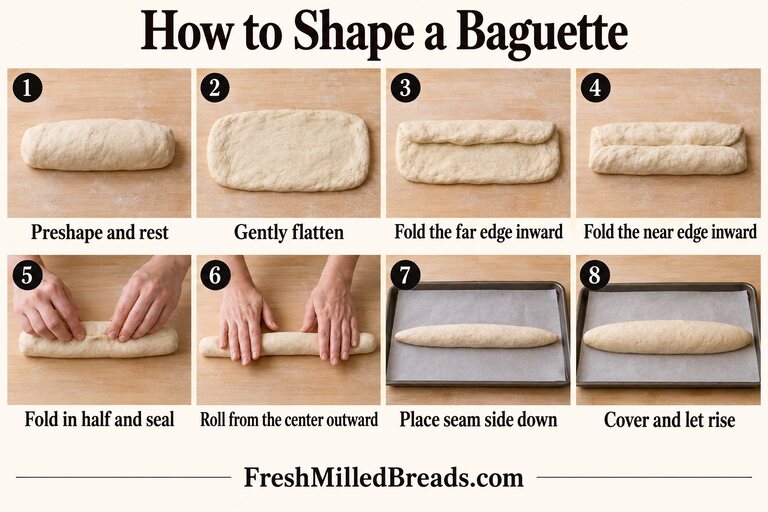
Turn the dough onto a lightly oiled work surface and divide it into 2 equal portions. Gently pre-shape each portion into a short log, cover, and let rest for 10–15 minutes.
Working with one portion at a time, gently flatten the dough into a rectangle. Fold the far edge inward toward the center, then fold the near edge inward toward the center. Fold the dough in half lengthwise and pinch the seam firmly closed.
With the seam underneath, roll the loaf gently from the center outward until it forms an even baguette shape. Place seam-side down on a parchment-lined baking sheet. Repeat with the second portion.
Let the Loaves Rise
Cover the shaped loaves and let rise for 30–50 minutes, until noticeably puffy. When gently pressed with a fingertip, the indentation should slowly spring partially back.
Preheat the Oven
While the loaves are rising, preheat the oven to 375°F.
Add the Salt and Caraway Topping
Gently brush the tops of both loaves with the beaten egg. Sprinkle evenly with the remaining ½ tablespoon caraway seeds and 1 teaspoon coarse salt.
Bake
Bake at 375°F for 25-30 minutes, or until the loaves are deeply golden brown and reach an internal temperature of 200–205°F.
Cool
Transfer the loaves to a wire rack and let them cool completely before slicing. This is especially important with rye bread because the crumb continues to set as the bread cools.

Baker's Notes
The dough should be soft and slightly tacky but strong enough to hold its shape. If it feels too stiff after kneading, add a small amount of water, 5 g at a time.
For the best structure, make sure the dough has developed good elasticity before adding the raisins and walnuts. The heavy add-ins can interfere with gluten development if they're added too early.
Storing & Freezing
Storing
Allow the loaf to cool completely before storing. Keep it in an airtight container or bread bag at room temperature for 2–3 days. For the softest texture, avoid refrigerating the bread, as refrigeration can cause it to dry out more quickly.
Freezing
Once completely cool, wrap the whole loaf tightly or slice it first for easier serving. Place in a freezer-safe bag or container and freeze for up to 3 months.
Thaw at room temperature while still wrapped to help keep the bread from drying out. To refresh the loaf, warm it in a 300°F oven for about 5–10 minutes. Individual slices can also be warmed briefly in the toaster or microwave.
Nutrition Information
About 24 servings per recipe · Serving size: 1 slice (approximately 55 g)
Calories: 105
- Total fat: 4 g
- Saturated fat: 1 g
- Trans fat: 0 g
- Cholesterol: 10 mg
- Sodium: 170 mg
- Total carbohydrate: 16 g
- Dietary fiber: 2 g
- Total sugars: 4 g
- Added sugars: <1 g
- Protein: 3 g
Reader Ratings
Cheryl S.
5 out of 5
Pleasantly surprised by this bread. We’re not huge rye lovers but had some grains on hand and decided to give it a go. The loaf was salty and sweet with a perfect crunch from the walnuts. Thank you for a great recipe!