
Recipe · Rolls & More
Fresh Milled Parker House Rolls
By: Eleen Beisner
Soft, buttery Parker House rolls made with fresh-milled hard white wheat and Kamut, folded with butter and finished with flaky sea salt.
Prep time: Approximately 3 hours (including rises) · Bake time: 15–22 minutes · Yields: 12 rolls
Ingredients
For the dough
- 250 g hard white wheat berries, finely milled (approximately 2 cups flour)
- 62.5 g Kamut berries, finely milled (approximately ½ cup flour)
- 225 g whole milk (approximately ¾ cup plus 2½ tablespoons)
- Up to 15 g additional whole milk, if needed (approximately 1 tablespoon)
- 57.5 g unsalted butter (¼ cup)
- 19 g granulated sugar (approximately 1½ tablespoons)
- 5.5 g fine salt (approximately ¾–1 teaspoon, depending on the salt)
- 3 g instant yeast (approximately 1 teaspoon)
- A little neutral oil for the bowl and work surface
For shaping and finishing
- 14 g unsalted butter, melted (1 tablespoon), for the folds
- 14 g unsalted butter, melted (1 tablespoon), for brushing after baking
- Flaky sea salt, to taste
Instructions
Prepare the milk mixture
Melt the 57.5 g butter in a small saucepan over low heat. Remove from the heat and stir in the 225 g milk, sugar, and fine salt. Let the mixture cool until lukewarm, about 95–105°F.
Hydrate the flour
Combine the freshly milled hard white and Kamut flour in the bowl of a stand mixer. Add the milk mixture and stir until no dry flour remains. Cover and let rest for 30 minutes.
Add the yeast and knead
Add the instant yeast and knead with the dough hook. Allow approximately 8–25 minutes total, depending on your mixer. Watch the dough rather than following an exact time: it should become smooth, stretchy, and elastic. It may still cling to the sides of the bowl.
If the dough feels stiff after several minutes of kneading, add the reserved milk a teaspoon at a time, letting each addition mix in before adding more. The dough should feel soft and slightly tacky while still holding its shape.
Let the dough rise
Transfer the dough to a lightly oiled bowl and cover. Let rise until noticeably puffy and about 1½ times its starting size, approximately 60–90 minutes.
Roll and cut the dough
Line two sheet pans with parchment paper. Turn the dough onto a lightly oiled work surface and gently roll it into a 12 × 12-inch square, about ¼ inch thick. If the dough springs back, cover it and let it rest for 5–10 minutes, then finish rolling.
Brush the dough with a thin, even layer of the 14 g melted shaping butter. Cut it into 3 columns, each 4 inches wide, and 4 rows, each 3 inches tall. You will have twelve 4 × 3-inch rectangles.
Fold and proof the rolls
Fold each rectangle across its 4-inch length, bringing the top edge just short of the bottom edge so a small lip remains visible. Gently press along the fold to help it hold its shape.
Place six rolls on each prepared sheet pan, leaving about 2 inches between them. Cover loosely and let rise until rounded and noticeably puffy, approximately 35–60 minutes. A gentle indentation should spring back slowly. Meanwhile, preheat the oven to 375°F.
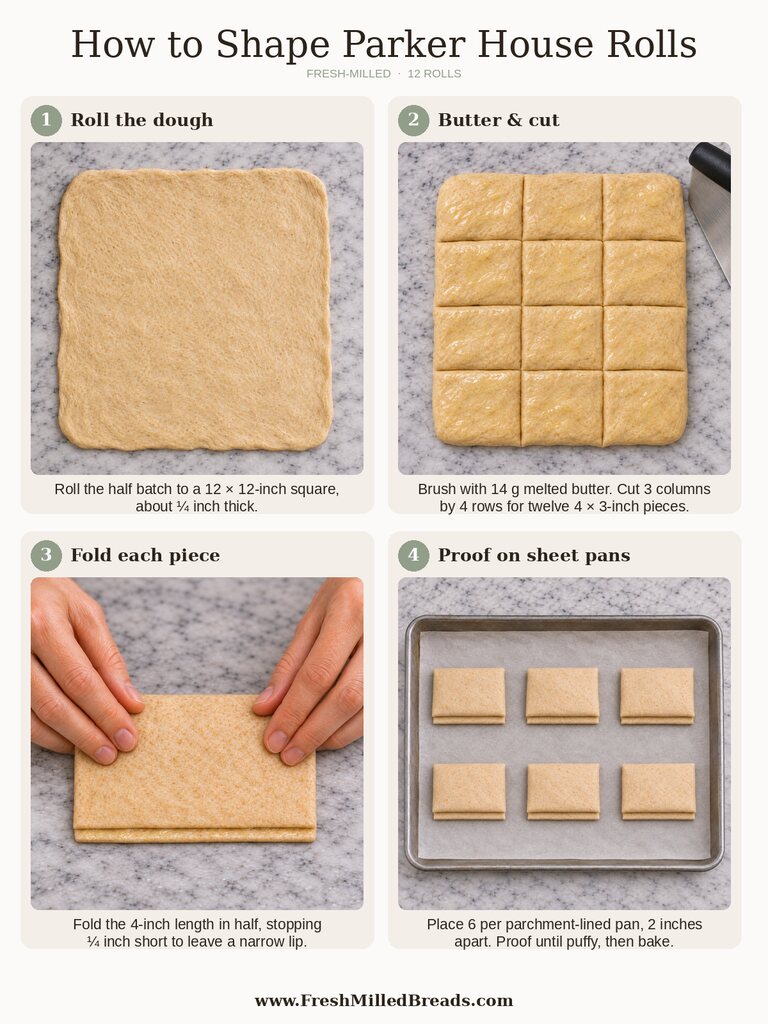
For this 12-roll recipe, use the full dough batch for the 12 × 12-inch square shown. The guide’s “half batch” wording does not apply. Bake
Bake for approximately 15–22 minutes, checking at 15 minutes. If baking both pans at once, swap their positions partway through for even browning. The rolls should be golden brown, and the thickest part of a roll should register 190–195°F. Insert the thermometer into the dough rather than the buttered fold.
Finish
Brush the warm rolls with the remaining 14 g melted butter and sprinkle lightly with flaky sea salt. Transfer to a rack and let cool slightly before serving.

Storing & Freezing
Storing
Allow the loaf to cool completely before storing. Keep it in an airtight container or bread bag at room temperature for 2–3 days. For the softest texture, avoid refrigerating the bread, as refrigeration can cause it to dry out more quickly.
Freezing
Once completely cool, wrap the whole loaf tightly or slice it first for easier serving. Place in a freezer-safe bag or container and freeze for up to 3 months.
Thaw at room temperature while still wrapped to help keep the bread from drying out. To refresh the loaf, warm it in a 300°F oven for about 5–10 minutes. Individual slices can also be warmed briefly in the toaster or microwave.
Nutrition Facts — Estimated
About 12 servings per recipe · Serving size: 1 roll
Calories: 160
- Total fat: 7 g
- Saturated fat: 4 g
- Trans fat: 0 g
- Cholesterol: 17 mg
- Sodium: 190 mg
- Total carbohydrate: 21 g
- Dietary fiber: 3 g
- Total sugars: 3 g
- Added sugars: 2 g
- Protein: 4 g