Recipe · Sandwich Loaves
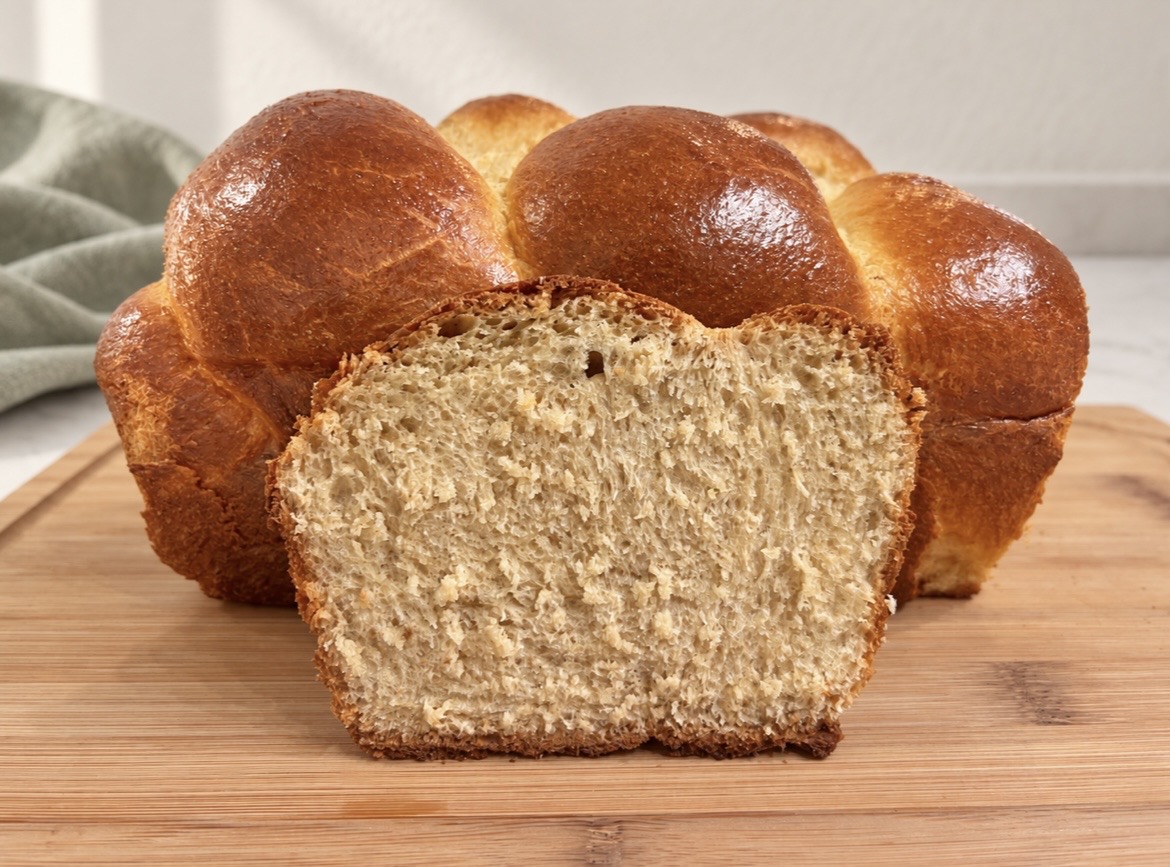
Fresh Milled Brioche Loaf
By: Eleen Beisner
A buttery, gently sweet brioche made with fresh milled flour, whole milk, and an extra egg yolk. Hard white wheat gives the dough structure, while Kamut adds a warm, nutty flavor. An overnight refrigerator rise develops flavor and makes the dough easier to shape.
Prep time: About 4–6½ hours (includes resting and rising; excludes overnight refrigeration and cooling) · Overnight ferment: 12–16 hours (overnight) · Bake time: 45–60 minutes · Yields: 1 loaf (16 slices)
Ingredients
Dough
- 360 g fresh milled hard white wheat flour — approximately 3 cups
- 90 g fresh milled Kamut flour — approximately ¾ cup
- 12 g vital wheat gluten, optional — approximately 1½ tablespoons
- 180 g whole milk, cool or room temperature — approximately ¾ cup
- 150 g whole eggs, weighed without shells — approximately 3 large eggs
- 18 g egg yolk — approximately 1 large yolk
- 60 g granulated sugar — approximately ¼ cup plus 1 tablespoon
- 9 g fine salt — approximately 1½ teaspoons
- 4 g instant yeast — approximately 1¼ teaspoons
- 150 g unsalted butter, softened but still cool and cut into small pieces — approximately 10½ tablespoons
- 10 g water, if using vital wheat gluten — approximately 2 teaspoons
- Up to 20 g additional water, only as needed — approximately 1 tablespoon plus 1 teaspoon
For the Egg Wash
- 50 g whole egg — approximately 1 large egg
- 15 g water — 1 tablespoon
For Greasing
- Approximately 14 g softened butter — 1 tablespoon, divided between the dough container and loaf pan
Instructions
Hydrate the Flour
Combine the hard white flour, Kamut flour, and optional vital wheat gluten in the bowl of a stand mixer.
In a separate bowl, whisk together the milk, whole eggs, and egg yolk. Include the 10 g water if using vital wheat gluten. Add the mixture to the flour and mix until no dry patches remain. Cover and rest for 30 minutes.
Begin Kneading
Add the sugar, salt, and instant yeast. Using the dough hook, mix until incorporated, then knead at the speed recommended for bread dough by your mixer manufacturer.
Allow the dough to become cohesive and noticeably stretchy before adding the butter. It may feel firm at this stage and will soften as the butter is incorporated. If it remains excessively stiff and tears easily, add the reserved water 5 g, approximately 1 teaspoon, at a time. You may not need any additional water.
Incorporate the Butter
Add the softened butter a few small pieces at a time, allowing each addition to mostly incorporate before adding more. Scrape the bowl as needed.
The dough may temporarily smear around the bowl or look separated. Continue mixing until the butter is incorporated and the dough becomes smooth and elastic.
Allow approximately 8–25 minutes total for kneading, depending on your mixer. Watch the dough rather than following an exact time—it should become stretchy, elastic, and smooth.
This includes the time spent incorporating the butter. If the dough is fully developed when the last butter addition is incorporated, kneading is complete; you do not need to knead for another 8–25 minutes.
The finished dough should be soft and tacky and stretch into a thin membrane before tearing. Small flecks of bran may interrupt a perfect windowpane. If the dough becomes warm or greasy, cover and refrigerate for 15–20 minutes before continuing.
Begin the First Rise
Transfer the dough to a lightly buttered container with room for expansion. Cover and let rise until approximately 30–50% larger, usually 45–90 minutes in a gently warm room. A cooler kitchen may require more time.
The dough does not need to double before refrigeration.
Refrigerate Overnight
Gently press the dough down to release large air pockets. Cover securely and refrigerate for 12–16 hours.
The dough will firm up as the butter chills and may continue expanding in the refrigerator.
Shape the Loaf
Butter a 9 × 5-inch loaf pan. Turn the cold dough onto a lightly oiled work surface and divide into three equal portions.
Roll each portion into a strand approximately 13 inches long. If the dough resists stretching, cover and let rest for 5–10 minutes before continuing.
Pinch the strands together at one end and braid loosely. Pinch the other ends together, tuck both ends underneath, and place the braid in the prepared pan.
Proof Until Puffy
Cover loosely and let rise in a gently warm spot, until substantially expanded and very puffy. This may take approximately 2½–4 hours, or longer in a cool kitchen.
The strands should look rounded and fuller, and the loaf should jiggle slightly when the pan is gently moved. A light fingertip indentation should recover slowly. Follow these signs rather than the clock; cold dough becoming soft does not mean it has finished rising.
Bake
Preheat the oven to 350°F with a rack slightly below the middle.
Whisk together the egg and water for the egg wash. Gently brush a thin layer over the risen loaf.
Bake for approximately 45–60 minutes. Tent loosely with foil once the top is sufficiently browned, around 15-20 minutes. The center should reach approximately 190–195°F, and the loaf should be fully set.
Cool
Let the loaf cool in the pan for 10–15 minutes, then carefully transfer it to a wire rack. Cool completely before slicing.
Baker's Notes
Vital wheat gluten is optional, but it provides additional support for this enriched whole-grain dough. Include the 10 g water when using it.
Keep the butter soft enough to press with a finger but still cool—not melted or greasy.
Avoid adding flour simply because the dough feels tacky or smears against the mixer bowl. Check its elasticity and temperature first.
In a kitchen around 70°F, the final rise may take approximately 3–5 hours or longer. Use the dough’s appearance rather than a fixed schedule.
If using a proofing mat, place a folded towel between the mat and the container or pan. Check the temperature near the dough and aim for gentle warmth around 75–78°F. Avoid direct contact with the mat.
Storage and Freezing
Storing
Once completely cooled, store the loaf tightly wrapped at room temperature for up to 3 days.
Freezing
For longer storage, slice and freeze in an airtight freezer bag for up to 2 months. Thaw slices at room temperature or toast directly from frozen.
Nutrition Information
About 16 servings per recipe · Serving size: 1 slice (1/16 of loaf)
Calories: 220
- Total fat: 10 g
- Saturated fat: 6 g
- Trans fat: 0 g
- Cholesterol: 75 mg
- Sodium: 245 mg
- Total carbohydrate: 25 g
- Dietary fiber: 3 g
- Total sugars: 4 g
- Added sugars: 4 g
- Protein: 6 g